When the savannah changes pace: learning how to read a day on safari
Our guide kept glancing at the sky.
It was one of our first days on safari, and the rain had been falling more heavily for several hours. The sky was grey, the clouds showed no sign of lifting, and we could see a hint of concern on our guide’s face.
When we asked what was wrong, she explained that it was not the rain itself that worried her, but the possibility of much heavier downpours arriving later.
During intense rainfall, many animals reduce their movements, seek shelter and remain hidden in the vegetation. This can make sightings more difficult and completely change the rhythm of a safari day.
And for several hours, that was exactly what seemed to happen. The savannah slowed down.
A seemingly quiet day
It was not completely empty.
We encountered a few elephants and some smaller animals, but there was none of the constant activity people often imagine before their first safari. The roads were wet, visibility was not always ideal, and much of the landscape appeared still.
Yet those conditions forced us to do something that, over the years, we would come to consider essential: slow down.
Instead of rushing in search of the next major sighting, we began to pay attention to the details. That was how we noticed a beautiful chameleon at the side of the road, almost completely hidden beneath a small bush.
We stayed with it for a while, watching its slow movements and changing colours. On a busier day, with several predator sightings being reported nearby, we might have given that moment far less attention.
A little later, north of Letaba, we came across an enormous herd of elephants crossing the road.
There may have been close to a hundred of them, moving past us one after another.
Seeing so many elephants together is far from ordinary. It was undoubtedly the main sighting of the morning, during a day that had initially seemed difficult.
We then stopped for a break. We had breakfast while the rain continued to fall, and by the time we set off again, something had begun to change.
When the rain stops
The downpour ended.
The savannah seemed to open up in front of us. Animals began leaving their shelters, movement returned to the roads and, suddenly, much of what had remained hidden for hours started to reappear.
That was when we encountered a large troop of vervet monkeys.
They were still wet and looked almost comical, their fur darkened and weighed down by the rain. Several of the females were carrying tiny babies beneath their bodies.
One female approached a puddle that had formed on the road. A very small infant clung beneath her while she supported it with one hand.
As she bent down to drink, the baby remained suspended under her body and looked directly towards us with enormous eyes.
We were only a few metres away.
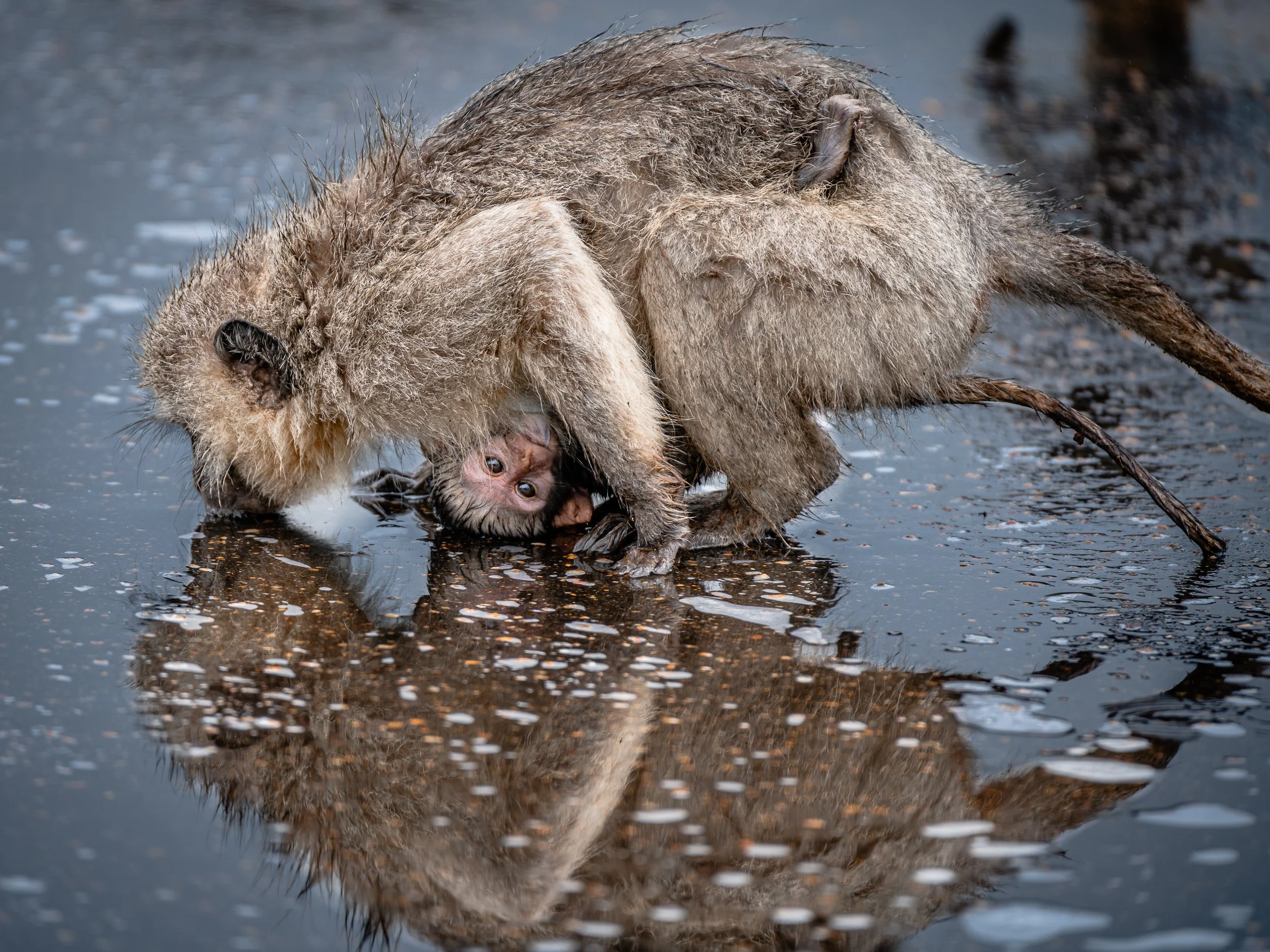
A mother vervet monkey drinks from a puddle while her baby clings beneath her body.
It was a simple moment and probably lasted only a few seconds, yet we still remember it as one of the most beautiful scenes from our early safaris. We also managed to take a photograph that remains very special to us.
It was not a lion.
It was not a leopard.
It was not one of the animals that usually appears at the top of a safari wish list.
And yet it became one of the most meaningful encounters of the entire journey.
That scene existed because of the rain: the puddle on the road, the animals still soaked, the mother stopping to drink and the baby watching us from beneath her.
Conditions that had initially seemed unfavourable had created a moment we would probably never have experienced on a dry day.
When the wind unsettles the savannah
Some time later, during one of our first self-drive safaris, we found ourselves facing a different kind of day.
During the first two hours, we saw very few animals. It was not only the predators that seemed to have disappeared; even the antelope and other herbivores normally found along the roads were unusually difficult to spot.
The answer was all around us.
It was extremely windy.
On very windy days, the savannah can become harder to interpret. Grass and leaves are constantly moving, familiar sounds are masked and scents can be carried in less predictable ways.
Both predators and prey may find it harder to understand exactly what is happening around them. Some animals become more cautious, reduce their movements or seek more sheltered areas.
It is not an absolute rule. Nature always finds a way to contradict our expectations. But it is something we have learned to take into account.
That day, once again, we decided to slow down.
And that was when we found a group of giraffes.
We stopped at a respectful distance, as we always do, allowing the animals enough space to decide whether to move away, remain where they were or come closer.
This time, they chose to approach us.
One after another, four or five giraffes began walking towards our vehicle. For a moment, we felt slightly intimidated. A giraffe is an enormous animal, and being surrounded by several of them creates a feeling that is difficult to describe.
We did not move forward at all.
They were the ones who came to us, quietly and curiously, watching us from close range. For a few minutes, it felt as though we had become the attraction on their safari.
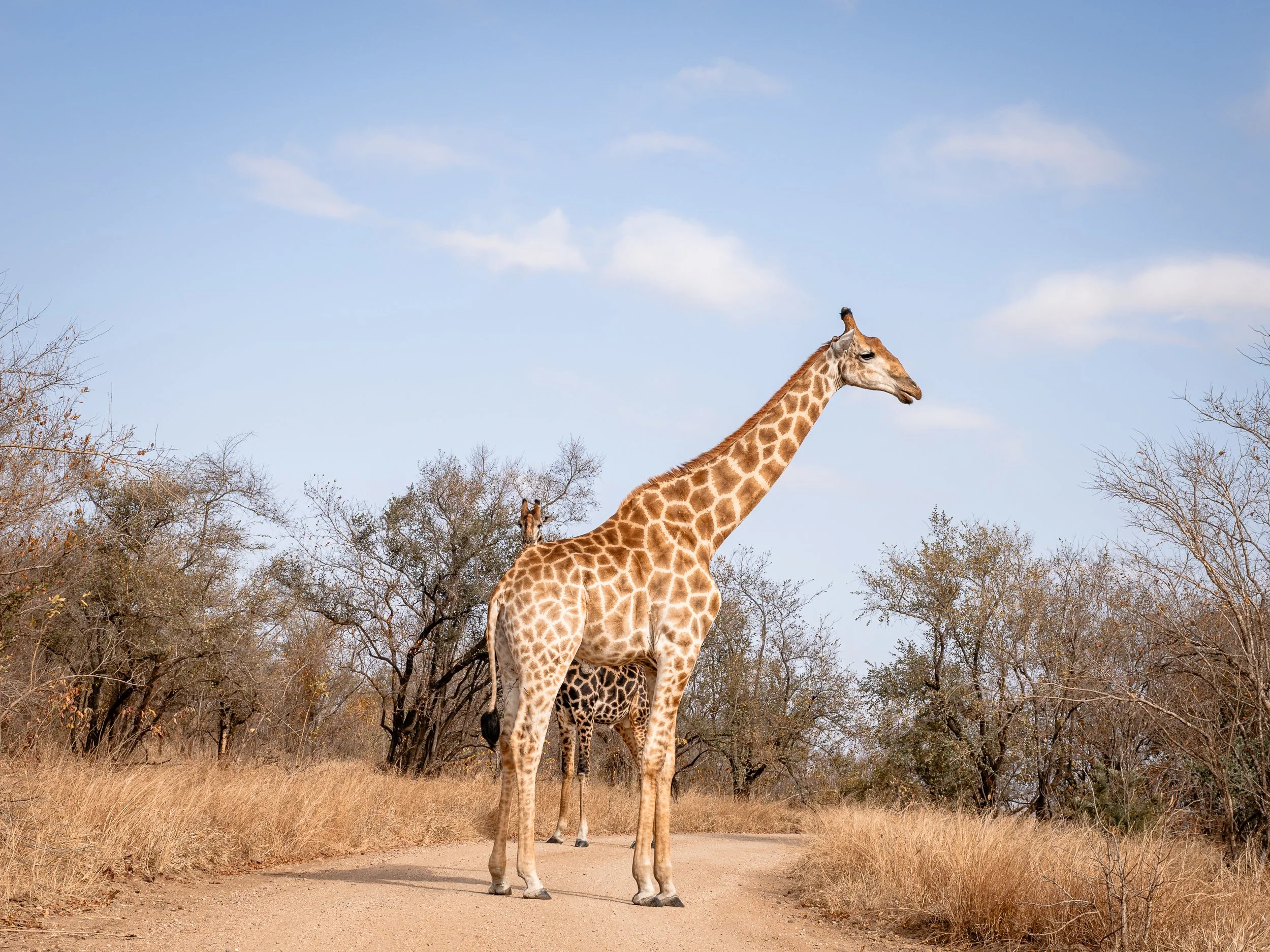
Two giraffes standing on a road during a safari in Kruger National Park.
We saw almost no predators that day. We may have spotted a few lions in the distance, partly hidden in the vegetation, but little more.
Even so, the giraffes remain the defining memory of that day.
Twenty-four hours later, a different savannah
The following day, the wind had dropped.
The savannah felt completely different.
Within a few hours, we encountered several prides of lions, a leopard, a cheetah and even African wild dogs. It was one of those rare days when everything seems to happen at once.
In the space of twenty-four hours, we had gone from a slow, seemingly quiet safari to a day filled with predator sightings.
Not because nature owed us anything in return.
Nature does not compensate, and it does not keep count of what we have or have not seen. Every day simply has its own balance.
Our role is not to expect the savannah to follow our plans. It is to recognise the rhythm it is offering us.
The landscape tells you where to look
With experience, you begin to read the landscape differently.
You do not search for every species in the same habitat.
When we cross an open plain with few trees and wide visibility, we know it may be suitable cheetah country. Open ground allows cheetahs to identify potential prey and use their extraordinary acceleration during a hunt.
That does not mean they cannot be found in more wooded areas, but open landscapes are often a logical place to begin looking.
When we follow a river, cross a dry riverbed or drive through an area with large trees and dense vegetation, our attention changes.
These are environments often favoured by leopards. They provide cover, access to prey and trees where leopards can rest, observe their surroundings or protect a carcass from other predators.
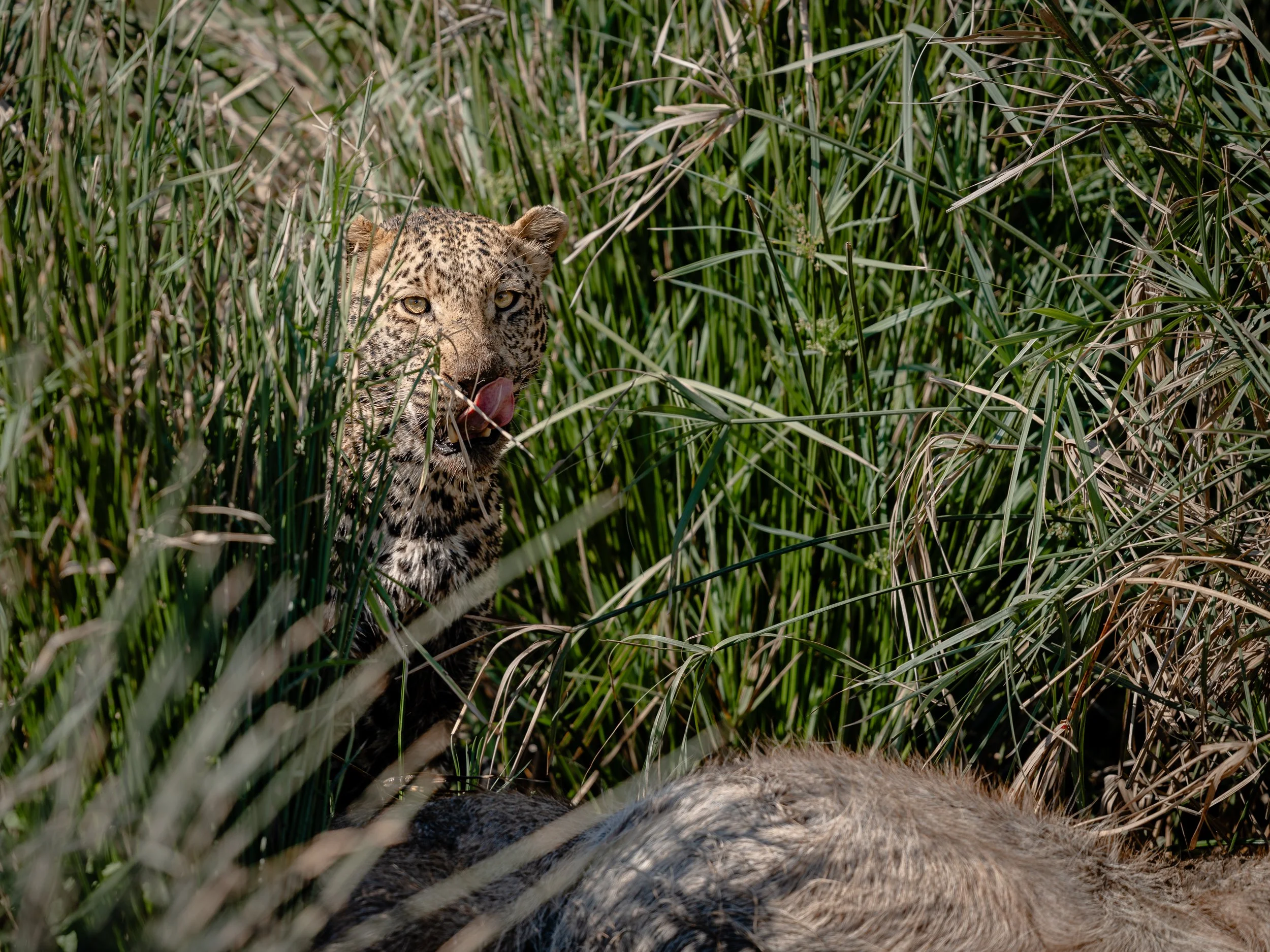
A leopard partly hidden in dense vegetation near a wetland area in Kruger National Park.
Searching for a leopard means learning not to expect the entire animal to be immediately visible.
Sometimes the first clue is a tail hanging from a branch, a paw, an unusual shadow or an antelope suddenly staring fixedly in one direction.
Weather conditions also influence how we search.
During the hottest part of the day, we pay greater attention to water, shade, thick vegetation and riverbeds. After rain, we look more carefully for animals leaving shelter, crossing roads or stopping to drink from newly formed puddles.
These are not formulas that guarantee a sighting.
They are possibilities.
Experience does not control nature
The more time we spend in the savannah, the more we understand that experience cannot tell us with certainty where an animal will appear.
What it can do is help us observe more carefully: to understand where an animal might seek shelter, where the water is, what type of habitat surrounds us and why several antelope have suddenly started looking in the same direction.
Above all, it teaches us not to consider a day unsuccessful simply because we did not find a lion or a leopard.
This is also how we want to experience and share safari with our guests: not simply by searching for an animal, but by trying to understand why it might be there, what it is doing and which clues led us to it.
The savannah does not owe us a perfect day.
All we can do is give it time, learn to recognise its signs and accept what it chooses to reveal.
Sometimes it will be a predator.
At other times, it will be the enormous eyes of a baby vervet monkey clinging beneath its mother.
And that is when a day that initially seemed difficult can become impossible to forget.