Seeing an Animal Is Not the Same as Encountering One
There are moments, during a safari, when you see an animal.
You watch it from a distance, perhaps lying in the shade, resting, moving slowly, or simply going on with its day without paying much attention to your presence. It might be a lion, an elephant, a giraffe, or a cheetah. And it is still emotional. You are there, in front of a wild animal, in its natural environment, and that alone would already be enough.
But then there are other moments.
Rarer, quieter, deeper moments.
The moments when an animal lifts its head, stops, looks in your direction, and for a few seconds seems to truly notice you. Not just the vehicle. Not just a movement. You.
That is when everything changes.
You are no longer simply seeing an animal.
You are encountering it.
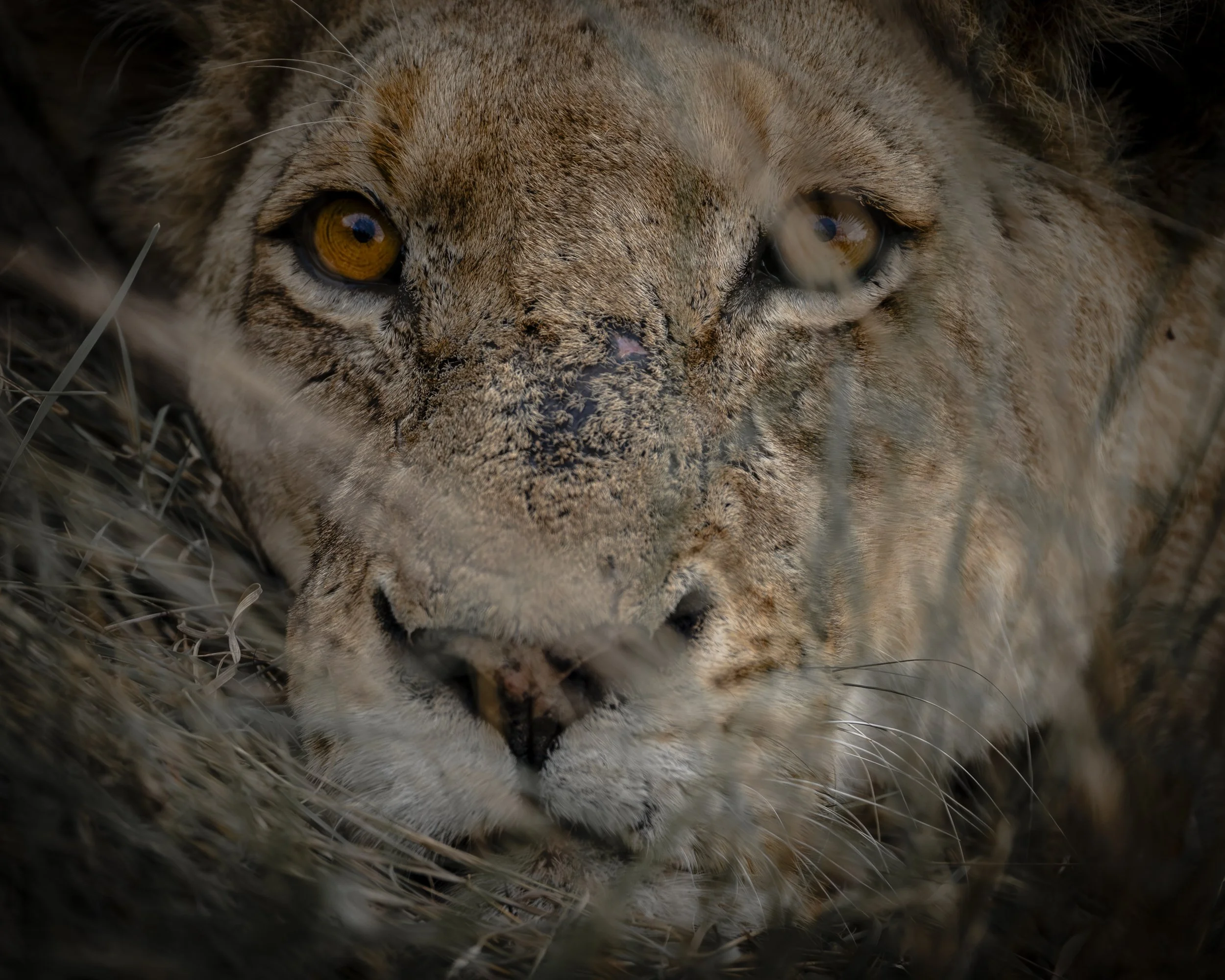
A few metres away. Looking straight at us.
The Look That Changes a Safari
In the way we photograph wildlife, eyes have always played an important role. But we are not only interested in them being visible, sharp, or beautifully lit.
What we are really looking for is something more difficult: a direct look.
An exchange.
That moment when the animal seems to look straight towards us, and the photograph no longer speaks only about the beauty of a species, but about the living presence of an encounter.
Not because we want to feel like the protagonists of the scene. In fact, on safari, you should never be the protagonist.
But because a direct look completely changes the weight of an image.
A photograph of an animal can document a species, a behaviour, a light, a landscape. But when those eyes seem to cross the distance between you and them, the image becomes something else. It becomes memory. It becomes emotion. It becomes an instant that keeps looking back at you long after it happened.
You can spend hours searching for a leopard among the branches, a lion in the tall grass, or a cheetah across an open plain. You can drive slowly, stop, wait, move on, turn back, follow tracks, read the behaviour of other animals.
Then, when you finally find it, the animal might stay in profile, sleep, look away, move through the grass and disappear.
You have seen a wild animal.
And that is already beautiful.
But when that same animal stops and looks at you, even just for a second, something happens that goes beyond the sighting.
It reminds you that you are not outside the scene. You are inside a living ecosystem. You are a guest in a place you do not control. And for one brief moment, that animal gives you its attention.
It is not yours. It is not there for you. It is not posing.
It is simply looking at you.
And that is exactly what makes the moment so powerful.
A Wild Look Cannot Be Forced
Of course, this kind of photograph does not come from simply pressing a button.
It comes from waiting. From patience. From the right light. From respecting distance. From the ability to read behaviour without entering the animal’s space.
For us, this is essential.
A wild look cannot be provoked. It cannot be forced. It cannot be chased.
It has to be waited for.
The kind of safari we love to live and tell stories about starts from there: full respect for the animals, slow movements, silence, time, attention. There are moments when it is better not to move forward even one metre. Others when it is better to switch off the engine. And others when you simply have to accept that the photograph will not come, because the animal has decided otherwise.
And that is exactly how it should be.
Nature is not a photography studio. Wild animals are not subjects at our disposal. They are free beings, with their own rhythm, their own space, their own energy.
Maybe that is why, when that look really does arrive, it means so much.
Because you did not take it.
It was given to you.
The Three Cheetahs of Kruger
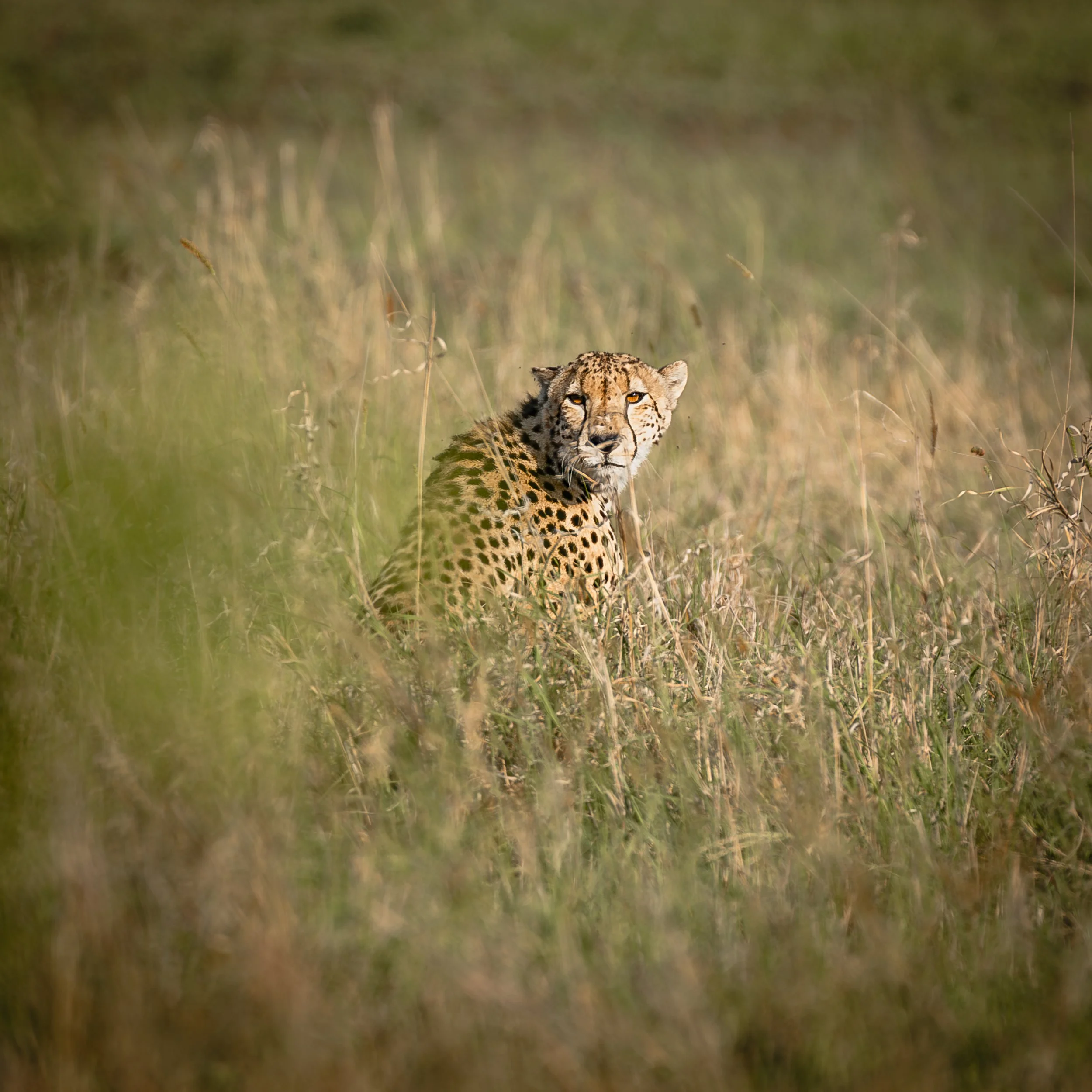
Something was moving in the tall grass. We waited.
One of the encounters I will never forget happened in Kruger National Park, in the Lower Sabie area.
It was one of our last days inside the park. Afterwards, we would be entering a private reserve for a couple of nights, together with a friend who was travelling with us. We were driving through the southern part of Kruger, an area I know and love deeply, when we crossed paths with a vehicle that gave us a slightly confusing signal.
They had seen a cat.
It was not clear which one. We thought they were trying to tell us it was a lion, maybe because of a plush toy they quickly showed from the car. They did not really stop for long. It was one of those typical safari signals: a few seconds, a couple of gestures, a rough indication, and then it is up to you to understand.
We continued in the direction they had pointed to and soon found a few vehicles stopped.
Not many. Two or three, maybe a few more. I asked a woman what they had seen. She told me she was not completely sure. She thought there might be a leopard, but she had not actually seen it herself.
So we stayed.
We waited.
On safari, very often, the difference between seeing something and seeing nothing is exactly that word: waiting.
Twenty minutes passed. Then thirty. Some vehicles arrived, others left. Some people lost interest. Some probably thought there was nothing left to see.
We stayed.
At one point, in the tall grass, I noticed something moving.
At first, it was only a shape. A hint. A movement that was different from the wind. Then, slowly, a head appeared.
It was a cheetah.
I still remember the exact feeling of that moment.
In Kruger, seeing a cheetah is never something to take for granted. The park is immense, almost the size of Wales, and these predators are among the most difficult big cats to encounter. According to the Kruger Maps & Guide updated in November 2024, there are around 120 cheetahs in the park.
One hundred and twenty.
In an enormous territory made of savanna, bush, endless roads, rivers, open plains, and places where an animal can disappear in a matter of seconds.
So that first cheetah alone would already have been enough.
I started photographing. A few photos, a few videos, trying not to miss the moment. He was looking around, elegant, light, with that unique presence only cheetahs have. They do not have the power of a lion, nor the nocturnal mystery of a leopard. They have something different. They seem made of speed, even when they are standing still.
Then, suddenly, another head appeared.
And a few seconds later, a third.
Three cheetahs.
Three brothers.
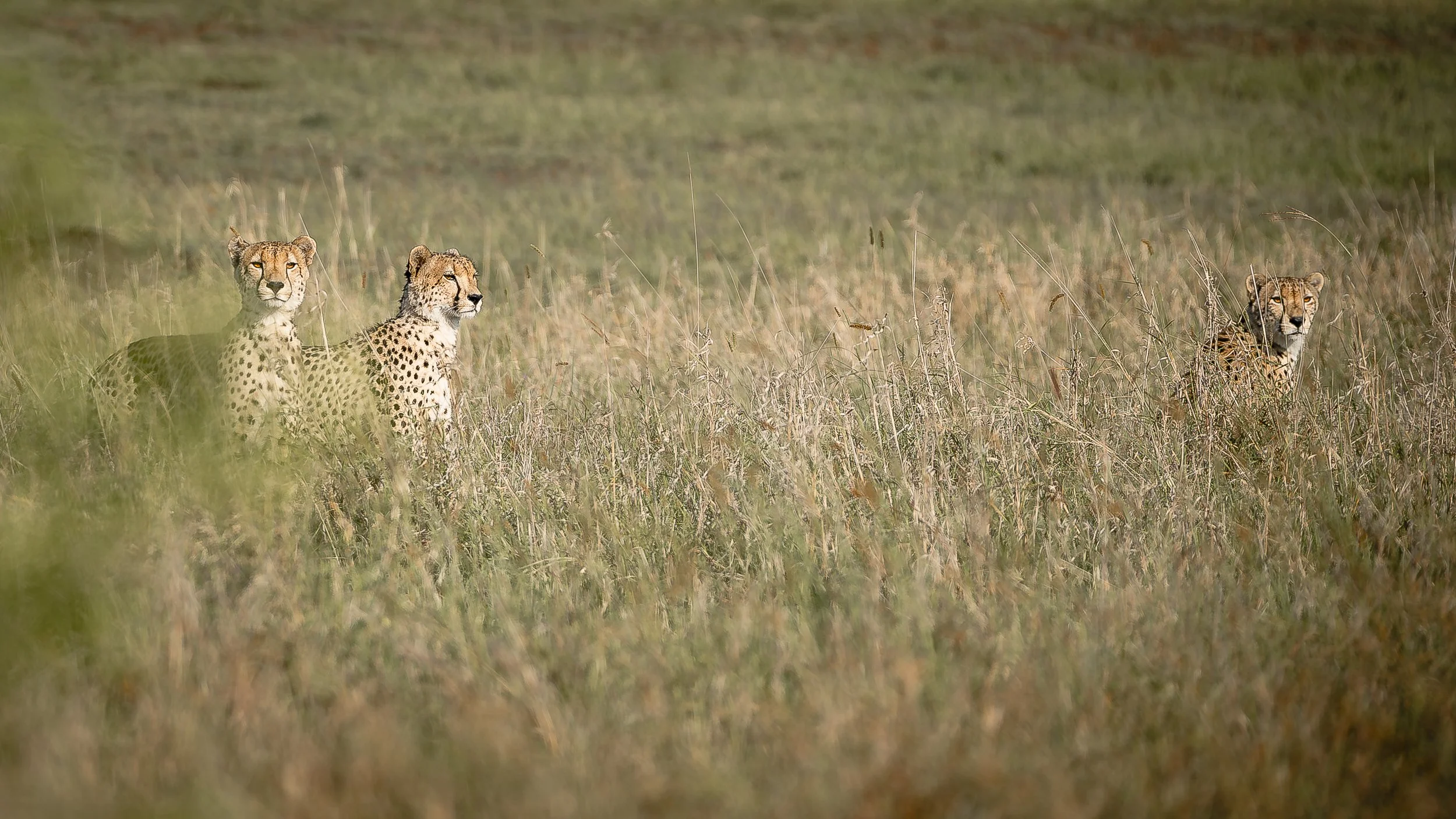
Then a second head appeared. And a third.
I remember a quiet wave of emotion among the vehicles around us. Not a loud noise, nothing that disturbed the scene. More like a shared, restrained reaction of disbelief.
Because seeing a cheetah in Kruger is already special.
Seeing three together, three brothers moving one behind the other through the grass, is a rare privilege.
I kept photographing, but at some point I realised that the emotion was stronger than the technique.
I had the camera in my hands, the scene in front of me, three cheetahs in the grass of Kruger, and yet I could no longer think only about the shot. Tears started to run down my face. I was trying to photograph them, but part of me simply wanted to stay there, watch, and breathe in that moment.
It was not the perfect photographs that made that encounter so important.
It was what was happening.
Those three animals were there in front of us, free, silent, present. And for a few moments, they looked in our direction.
It was not just a sighting.
It was an exchange.
We were looking at them.
They were looking towards us.
And between us there was everything: respect, luck, patience, beauty, and the impossibility of ever truly controlling what happens in Africa.
When Everyone Leaves
After a while, the cheetahs moved back into the grass and almost completely disappeared.
Many vehicles left.
That happens often on safari. When the animal is no longer clearly visible, many people lose interest. They start looking for the next sighting, the next scene, the next opportunity.
We decided to stay.
More time passed. Maybe another half an hour. The scene seemed to be over, but something told me it was not really finished.
Then the three cheetahs stood up again.
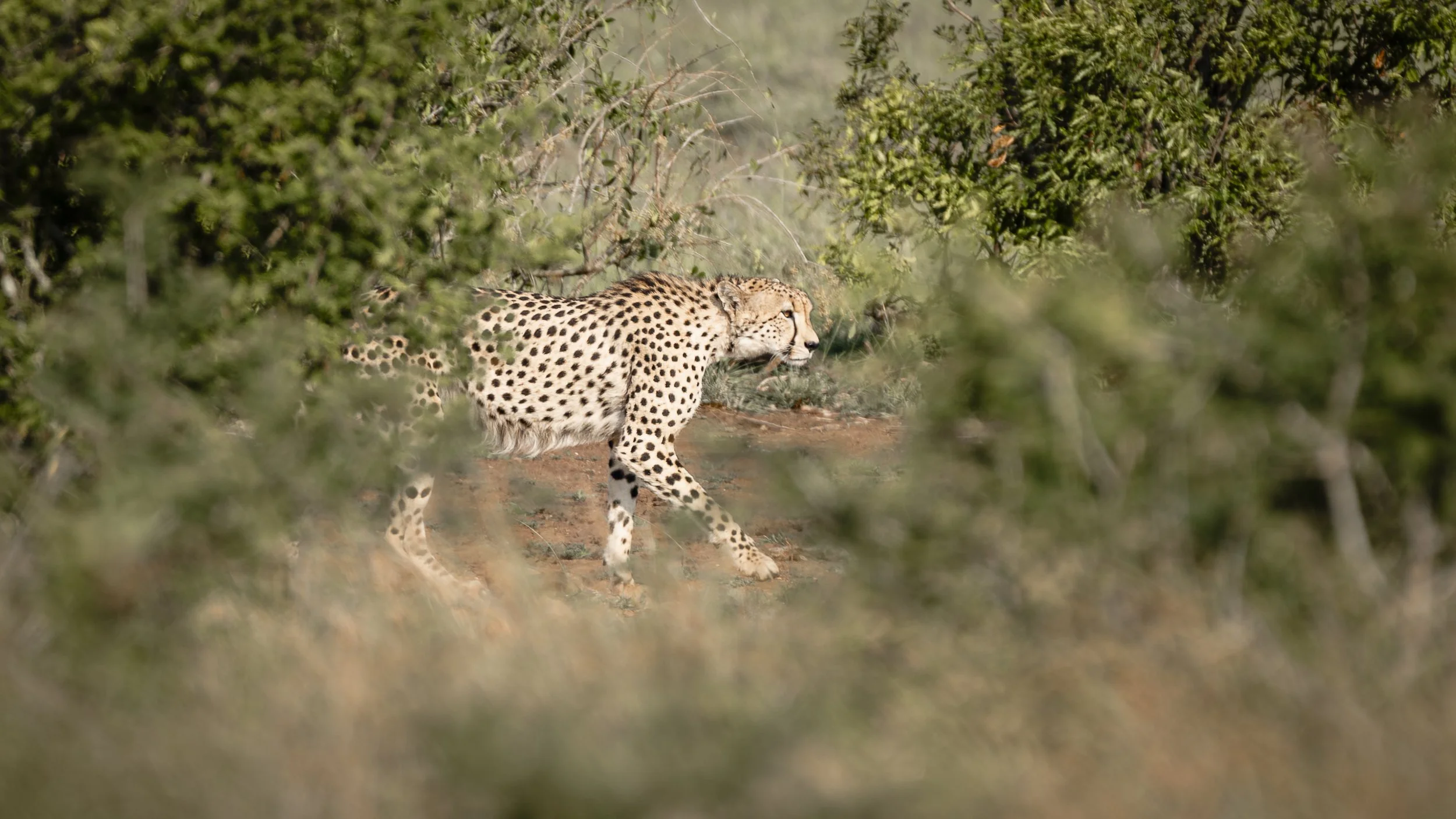
Free. In their world. For a moment, they allowed us to be there.
Once more, they looked in our direction. Then they began to walk, one after the other, crossing the grass about fifty or sixty metres away from us. They were not extremely close, but they were perfect like that. Free. Natural. In their own environment.
We followed them calmly, without pressure, trying to anticipate their movement without disturbing them. At one point, they moved into a more open area, next to a bush. From a distance, they were not easy to see. Anyone driving past without knowing they were there would probably not have noticed them.
And for a while, we were alone with them.
Alone with three cheetahs in Kruger.
There is not much more to add.
Some moments do not become important because they last a long time or because they produce the best photograph. They become important because they pass through you. Because, while you are living them, you already know you will never forget them.
That encounter was one of those moments.
Photography as Memory
When I look back at photographs of wild animals, I always realise one thing: not all images carry the same weight.
Some are beautiful because the light was good. Others because the composition works. Others because they show an interesting behaviour.
But then there are the photographs where the animal’s gaze comes straight towards you.
Those are different.
They are not always technically perfect. Sometimes there is a blade of grass in front, difficult light, a less-than-ideal distance, a frame that is not as clean as you would have wanted.
But if that look is really there, if you can still feel that moment when you look at the image, then the photograph has something you cannot create artificially.
It has truth.
That is why, when we photograph, we often look for that direct exchange. Not simply open eyes. Not simply a beautiful portrait. But a gaze that seems to acknowledge our presence.
A look that says: I see you.
It is a slow search, patient and sometimes frustrating. It requires time, respect, distance, and the ability to wait without demanding anything.
Because in the end, maybe this is what separates an image from a memory.
An animal can be inside a photograph.
Or it can remain there with you.
And when that happens, even just for a few seconds, the safari changes meaning.
You are no longer only standing in front of the wild.
For one brief moment, you feel the wild looking back.
Chanty & Marco